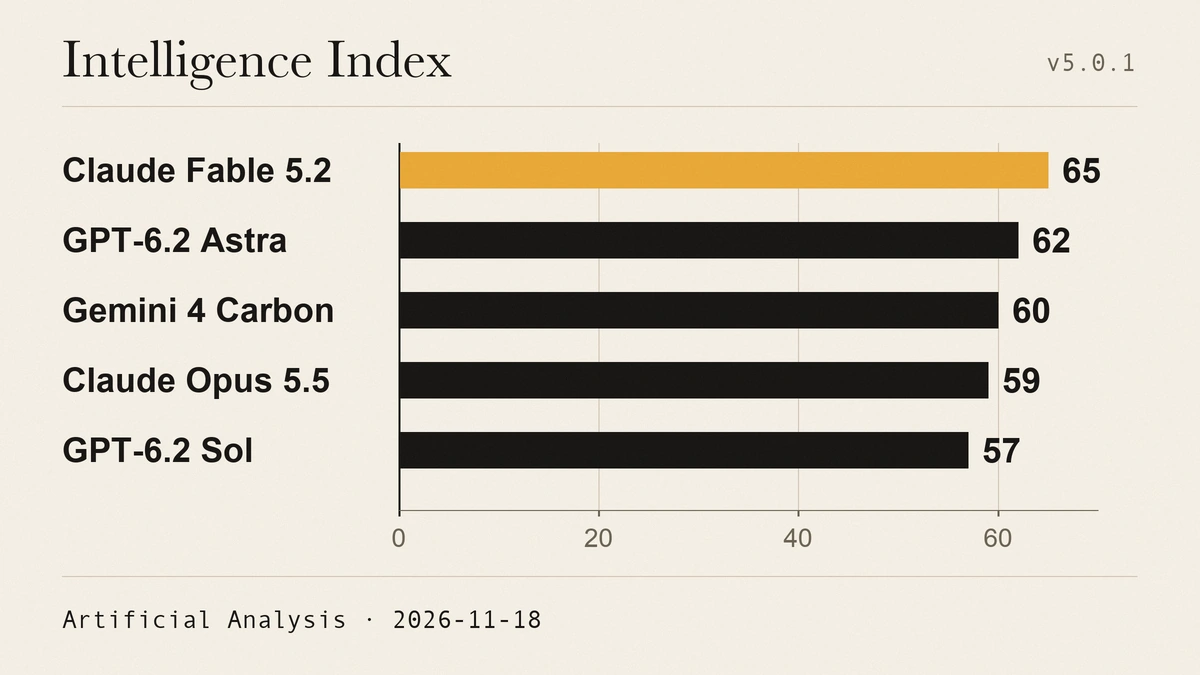
The top five AI models in the Artificial Analysis ranking
We took the five highest-scoring distinct models in the default Artificial Analysis table, using one configuration per model. These are the rounded scores and reasoning settings shown on 18 November 2026. The full ranking counts different settings for the same model as separate entries. Artificial Analysis model leaderboard
- Claude Fable 5.2 — 65 points, Max with the default fallback enabled.
- GPT-6.2 Astra — 62 points, Max.
- Gemini 4 Carbon — 60 points, High.
- Claude Opus 5.5 — 59 points, Max with the default fallback enabled.
- GPT-6.2 Sol — 57 points, Max.
Further down the same table, Gemini 4 Hydrogen scored 54 at Xhigh and GPT-6.1 Terra scored 51 at Max. Version 5.0.1 of the index combines nine tests. Knowledge work, coding, science and general knowledge each carry a 25% weight. Most tasks use English text. If you answer complaints in Polish, run a separate test in Polish. How Artificial Analysis calculates the index
How do OpenAI’s Astra, Sol and Terra differ?
OpenAI positions GPT-6.2 Astra for demanding analysis and engineering. A good test would be to find discrepancies between a request for quotation, three attachments and a pricing workbook. OpenAI recommends GPT-6.2 Sol for everyday work, coding and repeatable multi-step tasks. Give Sol the same documents when the job is to draft a response using an agreed template. OpenAI model selection guide
GPT-6.1 Terra is worth testing when the decisive piece of information is on screen. A distributor might ask it to read a variant code from a product card and enter it in the right field on a form. All three models are available through OpenAI’s API. The 6.2 versions of Astra and Sol were added on 17 November 2026. OpenAI API release history
When should you choose Claude Fable or Claude Opus?
Anthropic recommends Claude Opus 5.5 as a starting point for everyday coding and document work. It positions Claude Fable 5.2 for difficult, open-ended technical problems. Suppose you are rebuilding an old quotation calculator. Ask Opus to write tests for the documented discount rules. Give Fable the cases where the two calculators return different amounts and nobody wrote down the rule. Ask it to propose a rule and show a case that would confirm it. Anthropic’s guidance on Opus and Fable
Fable 5.2 is available through the Claude Platform and on paid Claude plans including Pro and Team. When testing an integration, record the model version, settings and cost of calls. That gives you a comparison you can reproduce after an upgrade. Claude Fable availability

Where does Gemini 4 Hydrogen fit?
Google designed Gemini 4 Hydrogen for fast execution on tasks involving tools. It positions Carbon and Argon for longer reasoning tasks. You can try Hydrogen through the Gemini API or Google AI Studio. A sales team could ask it to detect an enquiry’s language, select a service category and prepare a CRM record. The free Gemini app can select Hydrogen automatically. Google’s introduction to Gemini 4 Hydrogen
How do you choose a model for customer enquiries?
Take 30 past enquiries after removing personal information. Pick 20 routine cases and 10 that need clarification or a handover. Include one email with two conflicting collection dates and another where the part number appears only in a blurry photograph.
- Before the test, ask a salesperson to record the correct part number, date and next action for each enquiry.
- Give each model the same instructions, attachments and tools. Have the reviewer score the replies with the model names hidden.
- Record incorrect delivery promises, replies ready to send, minutes spent editing and time spent waiting. Score the difficult cases separately.
- Calculate cost per accepted reply. Add the cost of model calls to the cost of review time, then divide that sum by the number of accepted replies.
If a fast model answers routine questions accurately and flags doubtful cases for a salesperson, that can be your first deployment. Add a second model for cases where the trial shows it can resolve the issue. The local visibility report in KTBmatic is an example of a workflow you can break into smaller, verifiable steps. Explore the KTBmatic application